
The African Eye Institute contributes significantly to the development of public health and eye health through the following focus areas:
NOREC EYE FIX Funded by the Norwegian Government
This foreign exchange project aims to build capacity in optometric education in the context of eye health and global blindness prevention. This involved a series of professional exchanges to develop faculties for all partners, strengthen education systems, and affect change in global eye health. Connected through a partnership and mission, the AEI and the Masinde Muliro University of Science and Technology (MMUST) joined the University of South-Eastern Norway to form the EYEFX project. This foreign exchange project will support a passion for optometry and eye health across borders through an exchange of staff, culture, knowledge, and language. The partners are also keen to implement schemes that will open similar opportunities for the next generation of optometrists. www.norec.no
About Us
About Us
AEI recognises the vital role of education in building capacity to address avoidable visual impairment. In response to the shortage of optometrists across Africa — due to limited or absent local training programmes — AEI has partnered with national ministries and institutions to support the development of optometry education at selected universities and colleges:
- Mozambique – UniLurio
- Eritrea – Asmara College of Health Sciences
- Mali – IOTA
- Malawi – Malawi College of Health Sciences, Mzuzu University
- Uganda – Makerere University
- Cameroon – Yaoundé School of Nursing
- Kenya – Masinde Muliro University of Science and Technology
Key Outcomes
- 63 optometrists and 26 optometry technicians graduated across programmes
- 85 optometrists in South Africa completed AEI’s online myopia course
- Two new specialised courses in low vision and paediatric optometry launched in Kenya
In South Africa
- 280 health promoters, 144 primary healthcare nurses, and 50 school health nurses trained in primary eye care
- 180 outreach team leaders trained in cataract detection with the Gauteng provincial Department of Health)
- 100 individuals received refresher training
- 40 school health nurses in Eastern Cape and KwaZulu-Natal trained in primary eye care
AEI’s AFRICAN PARTNERSHIPS AND PROGRAMMES
Partnerships formed with key institutions in African countries were successful in building the workforce, with the additional benefit of promoting females, particularly those from disadvantaged backgrounds, in the eye health field. However, building the workforce must also be accompanied by infrastructural development.
South Africa – Giving Sight in KZN
Optometry clinics were established, equipped and staffed at the following public hospitals in KwaZulu-Natal;
- Port Shepstone Hospital
- Greytown Hospital
- RK Khan Hospital
- Wentworth Hospital
- Mahatma Gandhi Hospital
- Eshowe Hospital
- Ngwelezane Hospital
- Vryheid Hospital
- Edendale Hospital
- Dundee Hospital
- Tayler Bequest Hospital – Matatile
- Charles Johnson Memorial Hospital – Nqutu
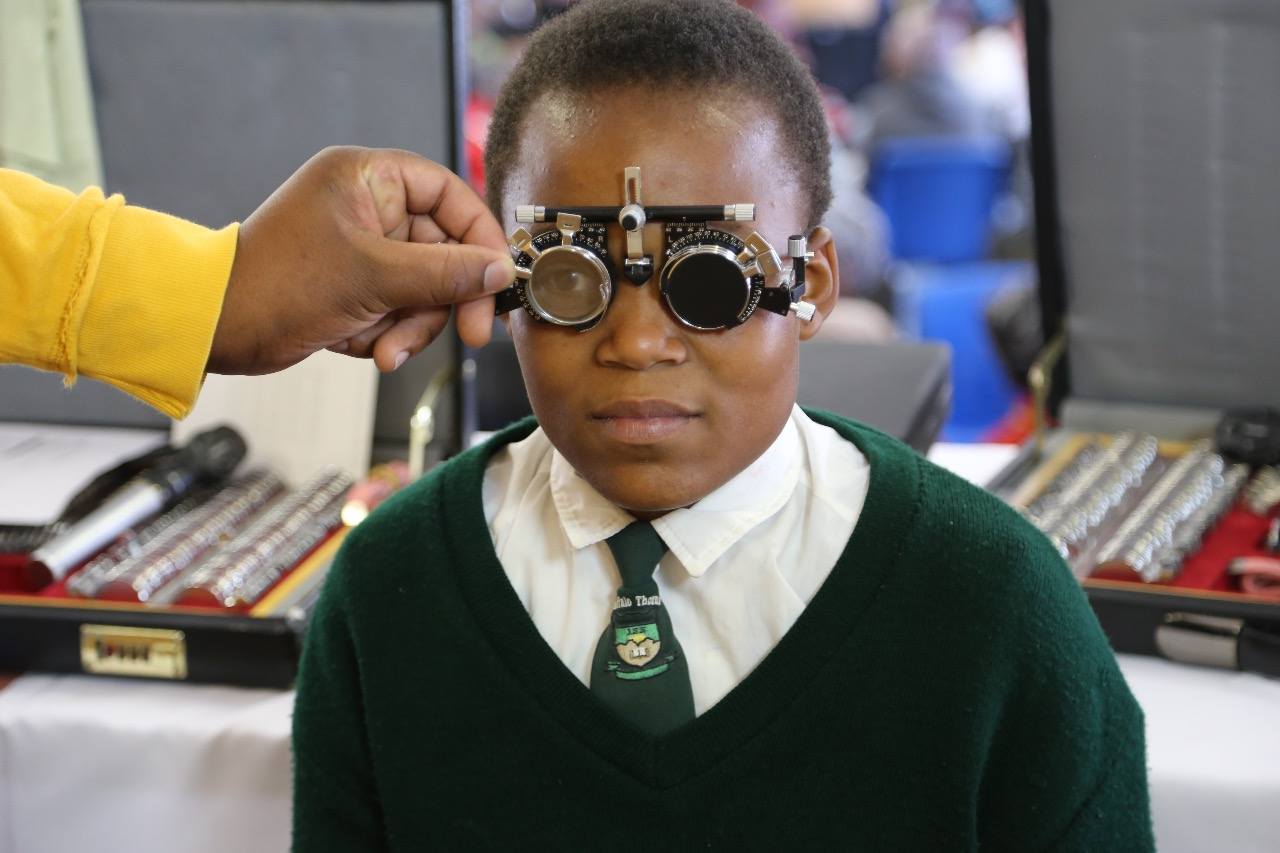
While these programmes focused on the development of adult professionals, children at school-going age require even more urgent attention to aid their development and educational outcomes. Children who cannot see well during their lessons, while completing homework, or playing on the school field are prevented from succeeding at school or developing socially. To promote paediatric eye healthcare, service delivery had to be enhanced, assisted by greater awareness, a bigger workforce, better infrastructure, effective policy and a focus on gender equality.
East Africa Child Eye Health programme (2012)
4 624 256 children aged 0 –15 years were screened across Kenya, Tanzania and Uganda (2 429 821 girls, 2 194 436 boys)
Our Children’s Vision project
A global initiative aligned with the World Health Organization’s Universal Eye Health Global Action Plan 2014 - 2019 resulted in:
14 399 850 children screened across the globe.
796 992 children received spectacles or low vision devices.
South Africa - The Giving Sight to Soweto, Giving Sight to Gauteng and We See projects
Collaboration with the Gauteng Department of Health and Standard Chartered Bank on the Seeing is Believing campaign allowed for the integration of eye care services into primary healthcare infrastructure. This resulted in:
404 721 people screened.
877 existing professionals trained.
6 optometrists employed.
10 eye care sites established/upgraded as follows:
*Chiawelo CHC
*Meadowlands Clinic
*Tladi Clinic
*Orlando Clinic
*Discovery Clinic
*Mofolo CHC
*Tshepisong Clinic
*Diepkloof Clinic
*Alexandra CHC
*Hillbrow CHC